
Where It Began
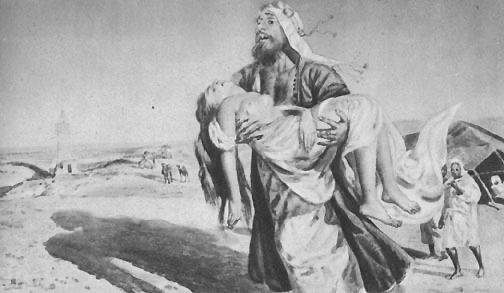
I may have been six or seven years old when I sat crouched on the floor of a dark corridor, my ear pressed close to a closed door. Inside, my father was rehearsing a performance with his students. His voice carried a poem by the Polish poet Juliusz Słowacki — the story of a father who, during the plague, had lost his seven children, one after another, and finally his wife.
In an instant, everything around me disappeared. The lonely father’s grief became mine. I could not shield myself from it.
Only much later did I understand the significance of this early encounter with art. The poem, borne by my father’s living voice, had made another human being’s suffering immediately present and awakened a receptivity to the pain of the Other.
That was where my orientation in the world began to take shape: a sense of what must not be allowed to happen, and of the responsibility that arises when another human being’s vulnerability can no longer be held at a distance — before I had words for it.
From this experience, Shibboleth would later grow: the artistic form, the concept, the research and the programme.

Art as a Detour to Responsibility
The Shibboleth Concept
Shibboleth grew out of experience: responsibility cannot be taught. It is awakened when the world breaks through our assumptions and defences — when the Other, in their vulnerability and dependence, can no longer be held at a distance.
Shibboleth was first developed for leadership, but it puts something more fundamental to the test: the human capacity to see, to remain and to respond.
In Shibboleth, artistic events alternate with writing, reflection and conversation. Through literature, music and human testimony, what is concealed, contradictory and painful becomes present. What emerges calls for a response.
When human suffering is no longer merely thought about but felt, responsibility ceases to be an abstraction and becomes an inner obligation, grounded in reverence for life and the dignity of the Other.
Where Art, Leadership, Psychology and Biology Meet
The Shibboleth Experiment
The Shibboleth Experiment began with blood. In an interdisciplinary, randomised study at Karolinska Institutet, fifty managers and around 200 of their co-workers provided blood samples before the managers were randomly assigned to one of two entirely different programmes: the art-based Shibboleth programme or a conventional leadership programme run by the Swedish Armed Forces.
The two groups developed in entirely different directions. The managers in the Shibboleth group changed — in their willingness to take responsibility, their self-knowledge and the way they related to others. In the comparison group, the development moved in the opposite direction.
The change did not stop with the managers. It reached their co-workers — who had never taken part in the programme themselves — and could also be read in their blood.
The differences did not diminish over time. On the contrary: eight months after the programme ended, the differences were greatest.

Leadership, Art, and Responsibility
The Shibboleth Effect
When does an experience become genuine change?
The book takes the experiment as its starting point but does not stop at its measurable effects. It follows the change from the outside and from within — through scientific measures and through the participants’ own, at times deeply affecting words about resistance, confusion and altered ways of seeing themselves and the world.
Yet the effect is not contained in numbers alone. The shock and beauty of art unsettle the managers’ habitual ways of judging — and their very sense of who they are. The change becomes visible in their words, in the way they bear responsibility, and in the traces it leaves in others. Shibboleth emerges as an inner threshold: something that cannot merely be understood but must be lived through.
The emphasis shifts away from the leadership role, methods and instrumental thinking, towards the human being behind the role — the one who holds power. This is not a handbook for becoming a better leader, but an inquiry into what may happen when power is willing to be tested by responsibility.

The Reading Is the Performance
Scensalong
At Scensalong, literature, music and two voices meet in a theatrical form in which the text remains at the centre. No roles, gestures or objects come between the words and the listener. The performance unfolds in the act of listening.
Afterwards, the space opens for conversation.

TEDx
"Can Poetry and Music Change Leadership?"
Julia Romanowska presents the Shibboleth Experiment and asks whether art can change how leaders exercise power and responsibility.

Dagens Nyheter Culture
"A Leadership Course with Kafka"
By Maciej Zaremba. In Swedish.
.jpeg)
Dagens Nyheter Opinion
"We Can Reverse the Trend in Mental Ill Health"
A research-based opinion article by Julia Romanowska and fellow researchers. In Swedish.


Between Art, Science and Responsibility
Julia Romanowska holds a PhD in medical science and is an author and percussionist. Shibboleth grew out of her work at the intersection of artistic practice, leadership, ethics and medical research.
At the centre of her work are the risks inherent in power: how, when we bear responsibility for others, we may cross moral boundaries and still preserve the image of ourselves as good. Her work explores how art can shake us out of our complacency and confront us with the reality from which we would rather shield ourselves.
At Scensalong, she has developed a distinctive theatrical form in which the reading itself is the performance.